
Prutehi Guahan, SHPO voice opinions over Programmatic Agreement
The Programmatic Agreement is a landmark operating document detailing how the U.S. military will conduct operations and construction activities inline with the National Historic Preservation Act. Its contents were put into question by activist group Prute
 By Super Admin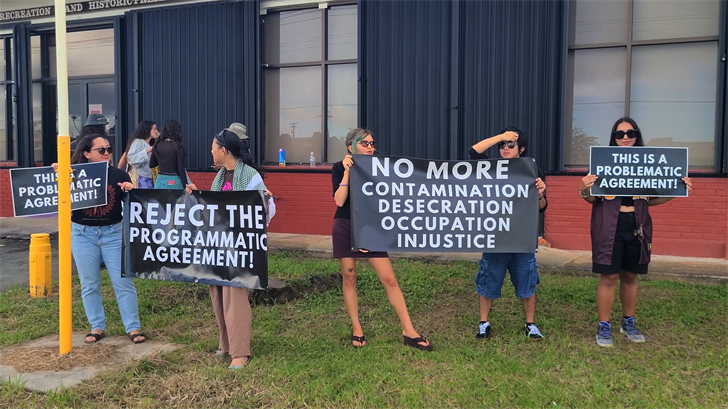
The Programmatic Agreement is a landmark operating document detailing how the U.S. military will conduct operations and construction activities inline with the National Historic Preservation Act. Its contents were put into question by activist group Prutehi Guahan, who protested outside the State Historic Preservation Office in Agana Heights to voice their opposition to what they deem as a lack of transparency and reduction in community input.
Prutehi Guahan's Monaeka Flores told KUAM News, "There are some things that we should be concerned about. For instance, the number of parties that have been a part of it have been reduced; the previous programmatic agreement included the history preservation advisory council, they've been removed. The number of signatories has been reduced; now it just takes one. And we're here today to protest at the state historic preservation officer's office because he helped to draft that programmatic agreement."
"He" being Patrick Lujan, Guam's state historic preservation officer, sits in a unique position: by definition, he's responsible both for liaising with the military on the PA's stipulations, and safeguarding the integrity of Guam's environment and our heritage. But he says the co-existence is simple, noting, "I think there's a misconception about what the Programmatic Agreement is. And they look at it as a relationship between our office and the military. And the military being, of course, our biggest customer on the island, making up the majority of the land usage. We're talking about almost 20 years of putting it into practice.
"Over time, we found some gaps, so we wanted to close it up, make it better and polish it up. It's not a new programmatic agreement; it's a pretty much a better one...it's fine-tuning. Instead of amending and just band-aiding here and there, we just decided to take a holistic look at it."
Flores, who led the protest, says the nature of her concerns and that of her colleagues is more than just surface-level, specifically about amendments. "The Programmatic Agreement is missing two very dense appendices that we need to see, and that's a total lack of transparency. And those include culturally-sensitive properties and land holdings of Joint Region Marianas," she said.
Lujan also says while this PA is the most discussed, it's not the only one and a key part of the business of co-existing with the feds. "It's a professional relationship. And the military's not the only customer and partner that we have. We've got programmatic agreements with FEMA, with Federal Highways, with US Fish & Wildlife; it's a very unique statute that allows the local SHPO office to have relationships with the federal agencies, and they have to work with us," he shared.
Nonetheless, voices were raised. And, to their point of those concerned, hopefully heard. Said Flores sternly, "We should all be deeply upset about this."
In similar fashion from the government's end, understanding and future dialogue can happen. "This agreement really is an operational agreement, it's a everyday thing. It's a living document, and this is what we do everyday," Lujan said.
"And there's got to be a trust factor that we're doing it in the best interest of the public."